
Self-Help Books That Actually Help
Explore 12 self-help books on self-worth, boundaries, your inner critic, and getting unstuck. Choose a topic first, then a format you want to spend time with: The Mindful Self-Compassion Workbook includes exercises, Set Boundaries, Find Peace offers practical scripts, and Maybe You Should Talk to Someone takes a memoir approach.
How we chose these books
- Recommended in real sessions — these are the titles our therapists suggest when a client's struggle has a book-shaped gap, and the ones clients bring in underlined.
- Clinician-heavy list. Most authors here are licensed therapists or researchers; the exceptions earn their spot by starting conversations that get people help.
- No hype picks. Nothing with a miracle timeline. See our three-part filter below for how we screen.
- Reviewed July 2026 by the Let'sTalk! Counseling clinical team.
On a budget? Nearly every title here is free at the Carrollton, Frisco, or Lewisville public library — or instantly through the Libby app with your library card.
A book is a start — not a substitute
If you would like to talk through something a book brings up, explore individual therapy in Carrollton or young adult therapy. Review rates and insurance, then ask about a therapist and appointment options when you are ready.
Self-compassion & self-worth
Most people try to fix themselves with the same harshness that broke them. The research is blunt: self-compassion outperforms self-criticism on every outcome that matters — motivation included. These four are where we point clients who treat themselves like an enemy.
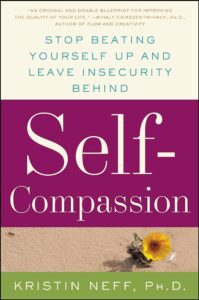
Self-Compassion: The Proven Power of Being Kind to Yourself
by Kristin Neff, PhD
Neff founded the scientific study of self-compassion, and this book makes the case that kindness toward yourself is a strength with hard data behind it — then teaches the practices. If “be nice to yourself” has always sounded soft to you, this is the book that changes the math.
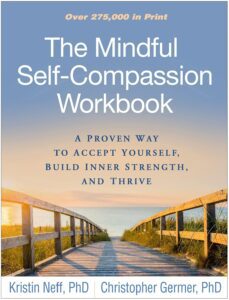
The Mindful Self-Compassion Workbook
by Kristin Neff, PhD & Christopher Germer, PhD
The practice companion: short guided exercises and meditations from Neff and Germer's 8-week MSC program. For people who read Self-Compassion and thought “okay, but how?” — this is the how, ten minutes at a time.
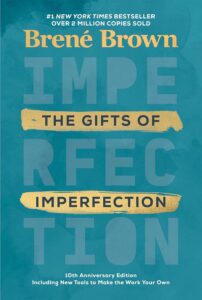
The Gifts of Imperfection
by Brené Brown, PhD, LMSW
Brown's ten guideposts for letting go of who you're supposed to be — the book on perfectionism and shame our therapists still recommend first, fifteen years on. Short, warm, and grounded in her shame research rather than platitudes.

Untamed
by Glennon Doyle
Part memoir, part permission slip. Doyle's story of dismantling a life built on others' expectations resonates hardest with women who've been the responsible one, the agreeable one, the fine one. Not a skills book — a courage book, and a book-club favorite for a reason.
Quieting the inner critic
You can't stop thoughts from arriving. You can stop treating every one of them as true. Two short books — one modern, one twenty-five years old — that teach that skill from different doors.
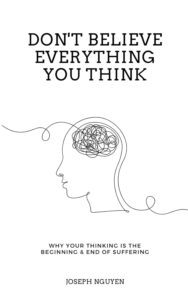
Don't Believe Everything You Think
by Joseph Nguyen
A slim, plain-language argument that suffering lives in our thinking about events more than the events themselves — and that you can let thoughts pass without boarding every train. Simple on purpose; several clients keep it in the car and re-read a chapter when spiraling.
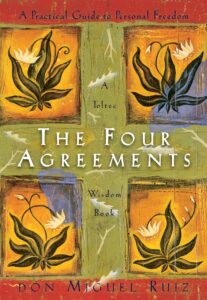
The Four Agreements
by Don Miguel Ruiz
Four rules — be impeccable with your word, don't take anything personally, don't make assumptions, always do your best — that hold up remarkably well as cognitive hygiene. The second agreement alone has ended a thousand ruminations in our office.
Boundaries & difficult relationships
“Boundary” became a buzzword; these books are the substance behind it. From the modern classic on saying the hard thing, to the older classic on losing yourself in someone else's problems, to two books for when the difficult person is family.
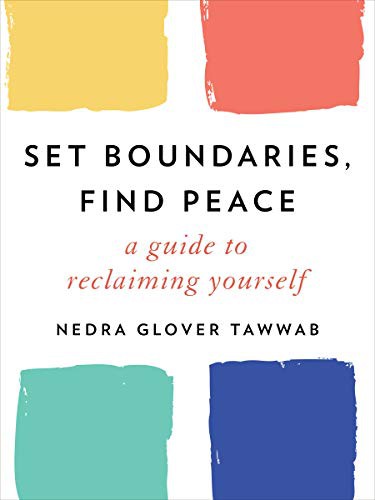
Set Boundaries, Find Peace
by Nedra Glover Tawwab, LCSW
A therapist's complete guide to boundaries: what they are, why guilt shows up the moment you set one, and word-for-word scripts for work, family, friends, and phones. The most practical book on this page — our most-recommended title for burned-out people-pleasers.
Codependent No More
by Melody Beattie
The book that named codependency — for anyone whose mood, schedule, and self-worth orbit another person's addiction, anger, or chaos. Beattie's core move still lands after four decades: you didn't cause it, you can't control it, and caring for yourself isn't abandonment.
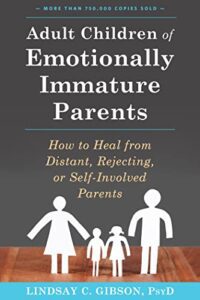
Adult Children of Emotionally Immature Parents
by Lindsay C. Gibson, PsyD
The quiet phenomenon of the last decade — because it puts precise words to a fog so many adults grew up in: parents who were present but never emotionally there. Gibson maps the four immature parent types and how to relate to them now without losing yourself again. Expect recognition on nearly every page.
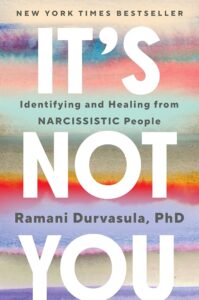
It's Not You
by Ramani Durvasula, PhD
Dr. Ramani's guide to recognizing narcissistic relationships and — more importantly — recovering from them: the gaslighting hangover, the self-blame, the radical acceptance that they won't change. Compassionate, current, and clear that healing is about you, not fixing them.
Momentum: two books people actually finish
Sometimes the assignment isn't deep healing — it's motion. One current phenomenon our clients keep bringing in, and one book that shows what therapy is actually like from both chairs.
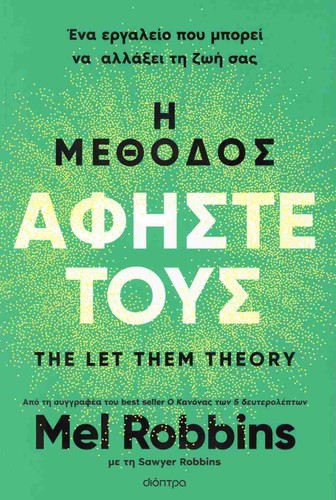
The Let Them Theory
by Mel Robbins
The two-word tool everyone's quoting: let them — let people misunderstand you, cancel, judge — then let me decides what you do next. It's a pop repackaging of radical acceptance and locus of control, and honestly, it works as a daily handle. We'd rather clients carry a simple tool than admire a perfect one.
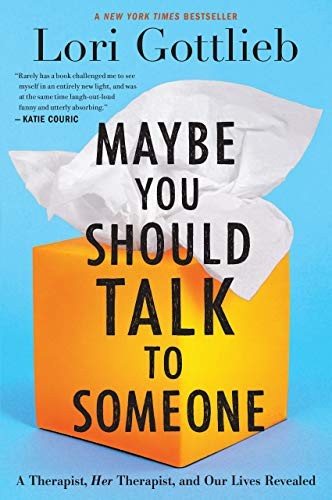
Maybe You Should Talk to Someone
by Lori Gottlieb, MFT
A therapist enters therapy after her own life cracks open, and takes you inside both chairs. Funny, devastating, and the single best answer to “what actually happens in there?” If someone you love is on the fence about counseling, this book has walked more people through our door than any ad we've ever run.
Book-club favorites on this page
Picking for a group — or a nightstand stack for a friend? The four we see passed between women most: Untamed, The Gifts of Imperfection, Maybe You Should Talk to Someone, and The Let Them Theory. Every one starts conversations that go somewhere real.
How to spot a self-help book that will actually help
Check who wrote it
Clinicians and researchers (Neff, Gibson, Tawwab, Durvasula) are accountable to evidence. Influencers are accountable to engagement. Both can be worth reading — but know which you're holding.
It should ask you to do something
Inspiration fades in about a week. A book that helps contains practices — scripts, exercises, experiments. If every chapter ends with a feeling instead of an action, it's entertainment.
Distrust miracle timelines
“Transform your life in 30 days” is marketing. Real change is boring on purpose: small practices, repeated, through the weeks where nothing seems to happen. The good books say so out loud.
Questions parents & clients ask us about these books
Where should I start if I don't know what's wrong?
Start with Why Has Nobody Told Me This Before? on our mental health list if symptoms (anxiety, low mood) are the loudest thing — or Adult Children of Emotionally Immature Parents here if relationships and old family patterns are. And “I don't know what's wrong, just that something is” is one of the most common and legitimate reasons people book a first session — naming it is literally what we do.
Are these good picks for women in their 30s and 40s?
That's who several were effectively written for — Untamed, The Gifts of Imperfection, and Set Boundaries, Find Peace speak straight to the decades of carrying everyone else's everything. The book-club shelf above is our short answer; add Maybe You Should Talk to Someone if you want the one people finish in a weekend.
Do self-help books work, or is it all placebo?
The skills-based ones work if you do the skills — that's the whole trick. Research on guided self-help shows real effects for mild-to-moderate anxiety and depression, and boundary/communication books demonstrably change behavior when readers use the scripts. What doesn't work is reading as a substitute for practice — or as a substitute for help when you're past the mild-to-moderate line.
My friend/partner needs one of these books. Should I give it to them?
Carefully — an unrequested self-help book reads as criticism (“you need fixing”). Better: mention what it did for you, or leave it visible and let them pick it up. If it's urgent enough that you're strategizing about it, the more honest gift is a conversation — and maybe our number.
More reading lists from our therapists
Reading is a start. Talking is a step.
Want to explore something from your reading with a therapist? Ask our Carrollton team about individual therapy, current openings, and in-person or online options. Confirm the fee or insurance arrangements for the therapist you are considering.
Let'sTalk! Counseling · 4125 Fairway Dr Suite 130, Carrollton, TX 75010 · (972) 885-1222
Serving Carrollton, Coppell, Lewisville, Flower Mound, The Colony & the DFW metro — in person and online.
Want our reading lists showing up first on Google? Add us as a preferred source